Room Calculation Before Painting: Estimate Paint Needed
Learn how to calculate room wall areas, estimate paint quantities and plan your painting budget in Nigeria. Use the BukkinHomes Paint Quantity Calculator to make your next project easier.
Preparing finishes & 3D renders...
Learn how to calculate room wall areas, estimate paint quantities and plan your painting budget in Nigeria. Use the BukkinHomes Paint Quantity Calculator to make your next project easier.

If you have ever bought paint for a room and still run out before the job was finished, you know how frustrating it can be. You may have to return to the shop, spend more money than planned or wait for your painter to continue working.
The opposite can happen too. You buy several extra buckets, finish the job and discover that you have spent money on paint you did not really need.
This is why room calculation before painting is worth doing before you visit the paint shop. A simple measurement of your walls can help you estimate the quantity required, compare paint costs and plan your budget more confidently.
if you are painting a bedroom apartment, duplex,or commercial building, the basic principle is the same: measure the surface, account for the number of coats and use the coverage information for the paint you intend to buy.
You do not have to calculate everything with a calculator and notebook, either. The BukkinHomes Paint Quantity Calculator can help you estimate the materials needed for your project.
Many people leave paint estimation entirely to the painter. An experienced painter can often make a useful estimate, but it is still sensible to understand the numbers yourself.
Paint is part of your finishing budget, and the quantity needed can affect how much you spend on the entire project.
Accurate measurement helps you:
Remember that an estimate is not a guarantee of the exact quantity that will be used. Rough walls, colour changes, application technique and the manufacturer's recommended coverage can all affect consumption.
The aim is to make a more informed purchase, not to pretend every wall behaves exactly the same way.
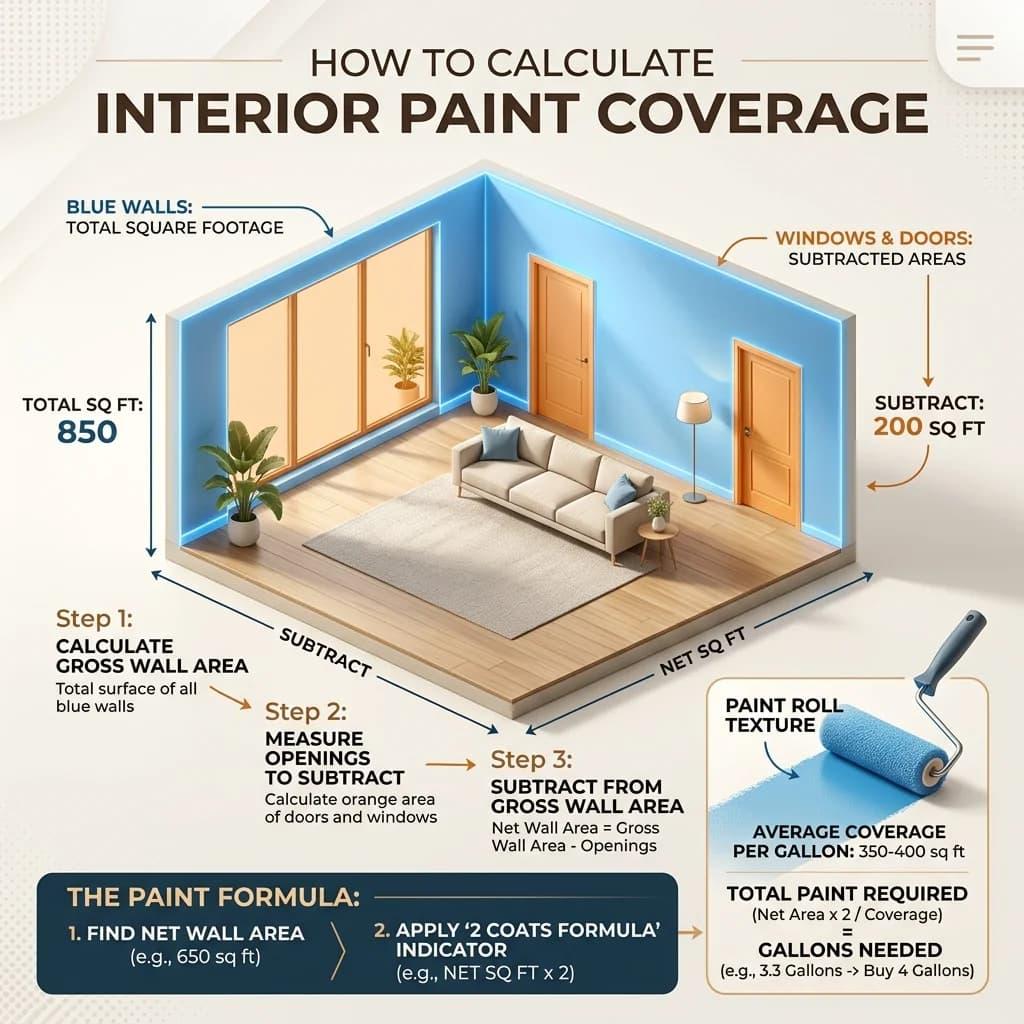
The easiest way to estimate paint for a rectangular room is to calculate the wall area first.
You will need a measuring tape, a calculator and the dimensions of the room. If you are measuring several rooms, write each measurement down so that you do not mix them up.
Measure the length and width of the room in metres.
For example, imagine a bedroom that measures:
To find the total perimeter, add the lengths of all four walls:
Perimeter = 4 + 3.5 + 4 + 3.5 = 15 metres.
This is the total distance around the room.
Next, measure from the finished floor to the ceiling.
For this example, assume the wall height is 3 metres.
Multiply the perimeter by the wall height:
Gross wall area = 15 × 3 = 45 square metres.
The room has approximately 45 square metres of gross wall area before deducting doors and windows.
You normally do not need to include the areas occupied by large doors and windows when estimating the paint required for the surrounding walls.
Suppose the room has one door measuring 0.9 metres by 2.1 metres and two windows measuring 1.2 metres by 1.2 metres each.
Door area = 0.9 × 2.1 = 1.89 square metres.
Window area = 1.2 × 1.2 × 2 = 2.88 square metres.
Total openings = 1.89 + 2.88 = 4.77 square metres.
Now subtract the openings from the gross wall area:
Net wall area = 45 − 4.77 = 40.23 square metres.
You now have an estimated wall surface of 40.23 square metres.
This example excludes the ceiling. If you intend to paint it too, calculate it separately.
Once you know the wall area, the next step is to account for the number of coats and the coverage rate of the paint.
The coverage rate tells you approximately how many square metres a litre of paint can cover under specified conditions. You can usually find this information on the product container or technical data sheet.
For illustration, assume your paint covers 10 square metres per litre per coat on the surface being painted.
Using our example room:
That gives an initial estimate of approximately 8.05 litres before allowing for practical losses or any additional surface requirements.
If you apply an illustrative 10% allowance, the estimate becomes approximately 8.85 litres.
This is not a universal coverage rate. Your actual paint may cover more or less, depending on the product, surface texture, colour, preparation and application method. Always check the manufacturer's instructions before purchasing.
Also remember that primer, undercoat and decorative finishes may have different coverage rates from ordinary wall emulsion.
Knowing the estimated litres is useful, but you also need to check the container sizes available for the product you want to buy.
For example, if your calculation suggests that you need about 8.85 litres, you should check which pack sizes the manufacturer sells. Two 4-litre containers provide only 8 litres, which is less than the illustrative estimate.
You could compare suitable pack combinations to find the most practical option without buying substantially more than necessary.
Do not assume that every paint brand uses the same container sizes or that every 20-litre product will cover the same area. The quantity of paint inside a container does not tell you its coverage on its own.
A 20-litre container of one finish may cover a different area from a 20-litre container of a thicker textured coating.
You may measure a room correctly and still discover that it needs more paint than expected. That does not necessarily mean the calculation was wrong.
Several things can change how much paint a wall uses.
Fresh plaster, unfinished cement render and some poorly prepared surfaces can absorb more paint than a smooth, properly prepared wall.
Depending on the condition of the surface, an appropriate primer or sealer may be needed before applying the finishing coats.
Screeding can create a smoother surface when it is correctly applied and prepared, but it does not guarantee a fixed percentage reduction in paint consumption. The result depends on the materials and the condition of the wall.
Painting a deep colour with a much lighter shade may require additional coats to achieve the desired appearance.
The result also depends on the opacity of the paint, the quality of the product and whether the existing colour has been properly prepared.
Ask your painter or paint supplier whether a suitable primer or undercoat is recommended.
If old paint is peeling, powdery or poorly attached to the wall, applying a fresh coat directly over it may not solve the problem.
Loose material and dust should be removed, and the surface should be repaired and prepared according to the coating manufacturer's instructions.
If the wall has persistent dampness, deal with the moisture source before repainting.
Do not estimate decorative coatings using the coverage rate for ordinary emulsion paint.
Stucco, textured exterior coatings and other specialist finishes can have different spreading rates and application requirements. Check the technical information for the particular product you plan to use.
Weather conditions matter because paint needs suitable conditions to dry and form a proper coating.
In humid coastal areas such as Port Harcourt and Calabar, moisture in the air and damp building surfaces can affect drying. During the rainy season, exterior painting may also need to be scheduled around rainfall.
During dry and dusty conditions, walls can collect dust that interferes with paint adhesion. Very rapid drying can also make application more difficult for some products.
Do not compensate for difficult conditions by adding excessive water to the paint. Follow the manufacturer's recommended dilution ratio and drying times.
The number of litres you calculate is only one part of the job. Proper preparation and application help ensure that the paint performs as intended.
If you are estimating paint for more than one wall or room, doing every calculation manually can become tiring.
The BukkinHomes Paint Quantity Calculator is designed to make paint estimation easier. Instead of relying entirely on guesswork, you can use the tool to estimate the quantity required for your project and plan your material budget.
Depending on the estimation option you use, you can enter your measurements, select the relevant material and account for the number of coats.
The BukkinHomes documentation also describes a fuller quotation workflow for estimating materials and costs, including options for labour and additional items.
Here is a simple way to get started:
You can begin with the BukkinHomes Paint Quantity Calculator https://bukkinhomes.com.ng/calculator, or open the open the calculator feature from the documentation https://bukkinhomes.com.ng/docs or navigate to the calculator directly from the website.
If you are painting an entire house or a property with unusual wall shapes, treat the calculator result as a planning estimate and confirm the requirements against the actual products and site conditions.
Calculating the right quantity of paint is useful, but the surface must also be ready to receive it.
Before painting begins, take time to:
These steps help create a sound surface for the finishing coats. They also make it easier to judge whether the quantity you estimated is likely to be sufficient.
Before ordering your paint, keep these points in mind.
Measure each room separately. Rooms with different heights or layouts may need different quantities.
Calculate ceilings separately. For a flat rectangular ceiling, multiply the length by the width. Complex ceiling profiles may require a more careful estimate.
Use the product's actual coverage rate. Avoid relying on a general figure when the manufacturer's technical data is available.
Account for the number of coats. A one-coat estimate is not enough when the project requires two or more coats.
Allow for realistic losses. Cutting in, roller loading, surface texture and minor wastage can affect the amount used. A 10% allowance can be a useful planning assumption, but it is not appropriate for every product or surface.
Buy enough from the same colour batch where possible. For larger projects, coordinating the same product and colour batch can help minimise visible shade differences.
Keep a record of your measurements. This makes it easier to compare quotations, estimate other rooms and plan future maintenance.
Measure the length of each wall and multiply each wall length by its height. Add the wall areas together, then subtract major openings such as doors and windows where appropriate. Multiply the net area by the number of coats and divide by the paint's stated coverage per litre.
There is no single quantity for every bedroom. The result depends on the room dimensions, ceiling height, openings, number of coats, surface condition and paint coverage. Measure the walls and use the coverage rate for the specific product.
The answer depends on the product's stated coverage rate and the number of coats. For example, at an illustrative coverage rate of 10 square metres per litre per coat, 20 litres would cover approximately 200 square metres for one coat under those conditions, or 100 square metres for two coats. Actual coverage can be lower on rough or absorbent surfaces.
For a basic wall estimate, you can subtract large door and window openings because you will not paint the space occupied by them. However, include any surfaces you actually intend to paint, such as wooden doors, window reveals or frames, in a separate estimate.
A properly prepared, smoother surface may allow paint to spread more evenly than a rough, absorbent wall. However, the actual difference depends on the surface, screeding material, primer and paint. Do not assume a fixed percentage saving without product-specific or project-specific evidence.
Yes, if your project requires primer. Estimate it separately using its own coverage rate, because primers and finishing paints may cover different areas per litre. Follow the recommended coating system for the particular surface.
A calculator can help you estimate multiple rooms and plan your materials. Accuracy depends on the measurements and product information entered, so measure carefully and check unusual surfaces, ceilings and decorative finishes separately where necessary.
A good painting project starts before the paint bucket is opened.
Taking time to measure your walls, account for openings and understand the paint's coverage can help you avoid unnecessary spending and reduce interruptions during the job.
If you do not want to work through every calculation manually, use the BukkinHomes Paint Quantity Calculator to help estimate your materials and plan your budget.
Measure carefully, choose products suited to your walls and allow enough time for preparation. A more accurate estimate, combined with good workmanship, gives you a better starting point for a successful painting project.
Our team visits your site, measures your walls, and recommends the right finish with a formal quote — free of charge.